
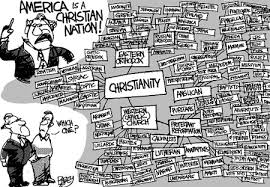
When one embarks on the road to salvation, his or her life is necessarily changed not only by a spiritual renewal, but also through social means. The reconstitution of the individual towards God requires a reconstitution of the individual in society. This element of change in the individual can be classified as “religious reorganization,” for religion consists of matters both spiritual and societal.
Societies are simply a compilation of individuals, a collection of persons composing a civilization. As such, when a considerable amount of individuals within a society reorient their lives to Christ—i.e. religious reorganization of one’s life—they are necessarily impacting society as a whole by interacting with the civil structures around them. Yet, in many societies which can be classified as a “Christian nation,” there is a disturbing lack of social Christianity, which naturally implies a lack of what constitutes social repentance.
The procedure for a Christian people to reorient their civil authority towards God has been produced, edited, assimilated, and reproduced repeatedly throughout Christendom as a historical movement. Political frameworks claiming to possess the organic Christian spirit have been a frequent occurrence throughout history within the vast and diverse body of Christ. From the imperial Western and Eastern Roman Empires of late antiquity to the Gandhi-inspired anarcho-pacifism preached by Leo Tolstoy, Christianity has provided a foundation for countless political platforms. The social implications of the Christian message have been interpreted numerous times through both political and interpersonal lenses; yet, had there been a perfect Christian system, it would not have fallen such as the great Christian empires or been snuffed out like the simplistic ideology of Tolstoyanism. That being said, there is an inherent presence of both political and interpersonal implications in the writings and teachings of the early Church.
Throughout its history, Christianity has sought to build what can only be modernly understood as communistic economic and social circles, echoing the format of the apostolic era when all Christians owned everything in common. Such institutional communes offered the Christian deliverance from materialistic cares and the ability to become of something larger than himself. Such settlements with peculiar communistic tenants have existed since the ancient days of the Christian Church; however, it struggles to perform the call to evangelize the world around it, and ultimately separates itself from the darkness of the world instead of ministering as a light within it.
Sign up for the Book of the Month Club and get exclusive access to Archbishop Jordan’s new book Prophet in the Marketplace.
How are you ministering to your community about the light of Christ?